

What Are Bitcoin Faucets?
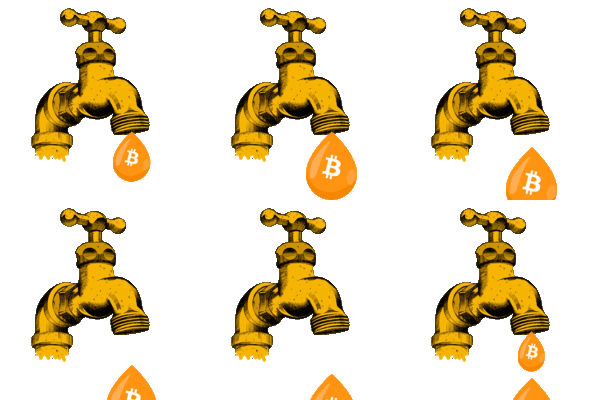
When we talk about Bitcoin faucets and cryptocurrencies in general, we are referring to websites that, as the English translation suggests, act as “faucets” dripping small amounts of digital currency.
They are almost all in English, although they are generally very intuitive to use, and may appear either as a single page within a larger website or as a dedicated portal with the specific purpose of rewarding users on demand with small amounts of cryptocurrency.
In addition to giving away digital currencies for free, faucets often have sections describing the currency they distribute and, in most cases, contain a substantial amount of advertising banners and pop-ups, which users must learn to avoid manually or with the help of appropriate browser extensions.
How Do Faucets Work? A Guide
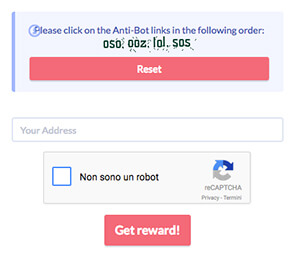
The basic structure of a faucet consists of a field where users enter their wallet address or the email address associated with a microwallet account (as in the case of FaucetPay) and a button for claiming digital currency. A Captcha, reCAPTCHA, or SolveMedia challenge is generally placed between the address field and the claim button. These are widely used systems designed to prevent automated claims.
The way faucets work is very simple: generally, all you need to do is enter the address of your Bitcoin or other cryptocurrency wallet in the appropriate field (a string such as 1HwsQPCNsrJoMHMVKYr3tkG6nUALkAMW7t), solve the Captcha (or equivalent), and click the button labeled “Claim,” “Get Reward,” or something similar.
Sometimes, the button below the Captcha is labeled “Continue” or something equivalent. This means that the digital currency claiming process involves more than one step. Clicking it takes you to a second or even third page, which generally contains an Antibot or a shortlink. The former is a system that serves the same purpose as a Captcha, namely verifying that the person making the claim is human and not a bot. Typically, the user is presented with a series of letters, numbers, or simple mathematical expressions corresponding to links scattered across the page, which must be clicked in the required order. The shortlink page usually contains a substantial amount of advertising, along with another Captcha to solve and a few seconds of waiting before being redirected to the faucet, where the user can finally claim their satoshis. Reloading the site and displaying a confirmation message that the funds have been credited complete the entire process.
When a faucet is connected to a microwallet, such as FaucetPay, the funds are credited instantly. In other cases, the amount accumulates in the user’s account balance until the payout threshold is reached, after which the user can make a withdrawal. In the latter case, the faucet may require a brief registration, or verification may take place solely through an email address or the user’s wallet address.
Why Do Faucets Exist? How Do They Make Money?
Faucets have been around on the web for many years, and their historical purpose has always been to introduce people to the world of cryptocurrencies (initially Bitcoin alone) by giving them small amounts of cryptocurrency. This allowed users to experience the phenomenon firsthand: by actually holding digital currency, they could learn how to use wallets and understand how transactions worked. Faucets therefore played a particularly important role in the early adoption of Bitcoin and the first cryptocurrencies.
Today, while they still serve this purpose, especially for new altcoins, they are primarily created to generate revenue from the advertising displayed on their pages. By giving away cryptocurrencies for free, faucet operators receive views and clicks on various banners and pop-ups in return, generating revenue that is generally paid by advertisers in traditional currencies.
This is, in fact, why the claiming process increasingly includes additional steps, redirects to external websites (shortlinks), or brief countdowns before users are allowed to click the various claim buttons. The goal is precisely to keep users on the site distributing the cryptocurrency for as long as possible, increasing the chances of advertising clicks and views.
Advantages and Disadvantages of Faucets

Cryptocurrency faucets are often the subject of criticism online. It is obvious that, despite giving away digital currencies with real value for free, they have not only advantages, but also disadvantages.
The harshest criticism is that faucets make little sense because they give away only a few thousandths of a euro per claim. From this perspective, they would simply be a waste of the user’s time, which could instead be spent learning more about the technology underlying cryptocurrencies.
This is partly true, but it should also be pointed out that, although the amounts are small, they are still a free reward in exchange for minimal effort. Furthermore, faucets should always be approached with the future in mind, taking into account the possibility that the current value of their rewards could increase in the years ahead.
For example, if today Ethereum faucets give away around 150 Gwei every 5 minutes, equivalent to approximately €0.001, it is possible that in a few years, if the price of this cryptocurrency rises, that small amount of Ether could be worth much more. This has already happened with Bitcoin in the past, when online faucets gave away thousands of satoshis in just a few claims, amounts that, at its current value, would be highly attractive to many people today.
Another argument against those who consider faucets a waste of time is that they give users the opportunity to own cryptocurrencies easily and without any investment or risk. This makes it possible to experience the world of digital currencies firsthand by testing online wallets, transactions, and trading on exchanges.
Even though the amounts are small, these handfuls of cryptocurrency often encourage users to learn more about what they actually own and about the technological potential of the projects behind them.
Faucets therefore represent an easy and direct way to become familiar with cryptocurrencies, often encouraging users to learn more about how they work.
Another criticism directed at these cryptocurrency-distributing websites is that they are overloaded with intrusive advertising and sometimes even engage in hidden mining, unlawfully using the user’s computing power. This is the obvious result of a faucet operator’s attempt to generate revenue in exchange for giving away cryptocurrencies for free.
However, there are now many ways to protect yourself from intrusive faucet advertising, such as browser extensions like AdBlock and various anti-pop-up extensions. Likewise, hidden mining can be prevented by using plugins such as No-Coin.
Finally, to address all the possible disadvantages of using online faucets to earn free cryptocurrencies without too much hassle, the best approach is to carefully select the best cryptocurrency faucets, such as those featured on this site. This allows you to optimize the claiming process by taking into account the size of the rewards, the advertising to avoid, the steps required to make a claim, and, most importantly, the amount of time you are willing to devote to it.